WHY HAVING YOUR MEDICAL RECORDS DIGITALLY MATTERS.
In many Nigerian homes, medical records reside in envelopes. Lab reports fold into drawers. Prescriptions tuck into handbags. When consulting a new doctor, patients search paper archives, hoping no important document is misplaced. Sometimes, results are lost. Healthcare fragments each visit starts nearly from scratch. In a country where patients move between hospitals, diagnostic centres, and pharmacies, record continuity is essential.
In many Nigerian homes, medical records reside in envelopes. Lab reports fold into drawers. Prescriptions tuck into handbags. When consulting a new doctor, patients search paper archives, hoping no important document is misplaced.
Sometimes, results are lost.
Healthcare fragments each visit starts nearly from scratch.
In a country where patients move between hospitals, diagnostic centres, and pharmacies, record continuity is essential. Without consistent documentation, vital medical history vanishes into memory.
Digital medical record storage is changing this pattern. Uploading and storing medical records securely online ensures continuity, clarity, and control.
Centralized, accessible medical information coordinates healthcare rather than scattering it.
Consider a patient running a liver function test in 2023. Two years later, mild abnormalities appear in follow-ups. Without previous data, determining if the change is significant or long-standing is difficult. Digital records enable immediate, meaningful comparisons.
Trends matter more than single numbers.
Chronic conditions like hypertension, diabetes, thyroid disorders, and kidney disease require ongoing monitoring. Paper records hinder tracking progress. Digital storage allows reviewing results over time, helping doctors make informed adjustments instead of reactive decisions.
Security concerns are common.
People worry about privacy regarding digital health data. That concern is valid. Medical information is personal and must be handled carefully.
Secure digital platforms use encryption to protect patient information. Access restricts to authorized users. Safeguards prevent public visibility or casual sharing.
Digital records can be safer than paper files that may be misplaced, damaged, or accessed by unauthorized individuals.
Mobility is another advantage.
Lagos is a transient city. People relocate for work, education, or family. Secure online medical records travel with you. You avoid reconstructing your history each time you change hospitals or cities.
Efficiency is another benefit.
When consultation and laboratory testing occur within connected systems, results upload directly to your profile. You avoid scanning documents repeatedly or manual data entry. Integration reduces errors and saves time.
For individuals managing fertility evaluation, chronic disease monitoring, or complex medical histories, digital record-keeping is especially valuable. Patterns become easier to detect. Follow-up becomes structured. Decision-making improves.
The process is straightforward.
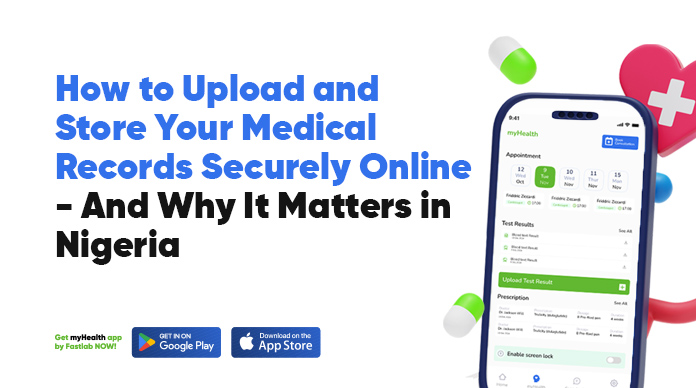
After receiving a laboratory report or medical document, upload it through a secure portal linked to your account. Once stored, it becomes part of your personal medical archive. Future consultations reference it instantly.
Instead of carrying files between clinics, you carry access.
Nigeria’s healthcare system evolves. As diagnostic services expand and telemedicine grows, record continuity matters more. Fragmented information slows care. Coordinated data strengthens it.
At Fastlab, the goal is to simplify this structure. Consultation, diagnostic booking, result interpretation, and secure record storage within one connected system.
Healthcare should not feel disorganized.
Your medical history tells a story. Preserving it properly ensures that story is understood accurately over time.Informed treatment depends not only on today’s test.
It depends on knowing what happened yesterday and tracking changes tomorrow.
Download myHealth App to get started with your consultation and securely storing your medical records.